Friday, February 7, 2014

VOYAGE IN ITALY (1953)

A.K.A.: Viaggio in Italia / Journey To Italy
Country: Italy
Genre(s): Drama
Director: Roberto Rossellini
Cast: Ingrid Bergman / George Sanders / Maria Mauban

Plot
A trip to Italy widens the emotional gap already threatening the marriage of a British couple.


What I Liked
Historically speaking, “Voyage in Italy” is a transitional film in the development of world cinema, most particularly of European cinema.  Director Roberto Rossellini takes the themes of Italian neorealism, which dominated that country’s moviemaking in the post-War years, and has them play out in a whole new manner which takes a sideways look at traditional storytelling.  Neorealism, for all its nonconformity, still told stories along the traditional structure we’re all familiar with: exposition, rising action, climax, falling action, conclusion; the operative word in all of this being action.  The characters cause things to happen, the characters must confront these things, and then we’re told that things are either back to normal or things will never be the same; then the movie is over.

What set neorealism apart from other movies of the era was that the people, events, and places involved were of relatively trivial importance when compared with the mainstream.  There was an intentional lack of kings, castles, cutesy kids, aliens, sword fights, gunfights, celebrities, talking animals, star-crossed lovers, wizards, monsters, magic, happy endings, or even attractive people; it was all gritty, down-to-earth studies of everyday people plagued with everyday problems, an approach that was very unique in the 1940s.  With “Voyage in Italy,” Rossellini takes that focus on the importance of the banal and puts it not in the action on screen but in the relationship between his main characters, to whom not much really happens in the way of external events.  Thus the story does not play out in a series of experiences happening to our characters, but in feelings happening between them.  The pendulum-like emotional sway of a husband and wife away from one another (emotionally), then closer, then further away, and then back again is the entire story.  If you think about it, this approach to exploring conflict is much more life-like than the traditional one, isn’t it?  How many of life’s real problems fit into the traditional story structure we’ve all learned since childhood?  Few if any.  Our problems are a better fit for the nonlinear and subtler approach Rossellini brings to “Voyage in Italy.”

Sounds boring, doesn’t it?  Well, yes, on the surface it can be; but that’s a little bit of what Rossellini was intentionally going for, actually.  That’s because his characters are bored, too.  They are so tired of one another, of their life together, and of their inability to enjoy any intimate connection at all, that they pretty much self-destruct when what is supposed to be a romantic vacation turns into a dull exercise in mutual irritation and contempt.  That boredom, irritation, and contempt, and the impending collapse of a relationship are portrayed with a level of accuracy likely unprecedented in film history up to that point, and that’s what makes the movie fascinating: how real it all seems.


What I Didn’t Like
I felt that Rossellini somewhat betrayed his revolutionary approach to storytelling by finally having something happen – even if it is completely believable – to the couple at the very end.  This happening then brings about an abrupt end to the film, wrapping things up a bit too nicely for a film that had spent so much time exploring the complexity of a relationship.

Both of the main characters are portrayed by very well-known English-speaking actors, Ingrid Bergman and George Sanders, which makes sense, since they are playing two English people familiar to one another travelling through a strange land, Italy.  Unfortunately, I couldn't find the version of the film in English.  This left me with the Italian-released version, which is both subtitled and overdubbed.  Normally I don’t mind subtitles at all.  But the fact that the actors were originally speaking their lines in English, then were overdubbed in Italian for release in that country, and then subtitled in English proved distracting for this English-speaking viewer.  I’ve seen both Bergman and Sanders in multiple other movies and admire them both as actors.  That I couldn’t hear them speak their lines as they were spoken was frustrating and irritating.  Then again, that the emotional turmoil of the characters still moved me, even with the problem of the subtitled overdubs, speaks to how well the actors could communicate, even without their voices.


Most Memorable Scene
Outside of the unconventional story of a relationship, the film has another appeal found in it’s setting.  As a tourist, Bergman’s Mrs. Joyce visits several memorable locales in and around Naples.  Vesuvius, the catacombs, various ruins, the sybil’s site, Pompeii, and a museum.  Each of these scenes is shot on location and make for fascinating viewing for the audience, who get to be tourists by proxy.  Even in sixty-year-old black and white pictures these ancient sights and places are extraordinary.


My Rating: 4 out of 5

Wednesday, February 5, 2014

REQUIEM FOR A DREAM (2000)

Country: U.S.A.
Genre(s): Drama
Director: Darren Aronofsky
Cast: Jared Leto / Ellen Burstyn / Jennifer Connelly

Plot
Four people, feeling unable to fulfill their deepest desires, comfort themselves with drugs, losing themselves and each other to their addictions.


What I Liked
I’m pretty well convinced that Darren Aronofsky can do no wrong.  Of course, I’ve yet to see “The Fountain,” but I’ve seen all of his other movies.  Each and every one of them is among the most unforgettable films I’ve ever seen.  On an emotional level, “Requiem for a Dream” is the most devastating of them all.  It’s about as repulsive as staring into a public port-a-potty toilet for two hours, and yet it is somehow simultaneously a thing of absolutely beauty.

The toilet is of course the subject matter: likable human beings destroying themselves on every level for no good reason.  Aronofsky puts the grimy, nauseating reality of addiction on display through the use of surrealism.  The slow motion, the fast motion, the off-kilter camera angles, the dizzy point-of-view shots, the fast cutting, the uncomfortable close-ups, they’re all there not just to show off but to drive home the disjointed, nightmarish experience of the characters.

And that’s the beauty of it.  In Aronofsky we have a master of his craft, still very young when this movie was made, who has assembled a near-perfect portrait of that thing all Americans are trained to either deny or despise: failure.  In his hands, it’s all so wonderfully rendered, so painfully poignant, that one can’t help but admire the grotesque beauty.  Each of the film’s four protagonists is after some image of what we are all supposed to want: family, respect, success, and love.  It is their relatable pursuit of these supposedly all-American ideals that is most heart-breaking as it leads each of them into a personal Hell.  After all, each of us has our own thing too, whether it's drugs, alcohol, sex, television, junk food, violence, porn, nicotine, caffeine, energy drinks, crime, or whatever else is your fix.  You just haven't let it destroy you.  Yet.

Even forgetting Aronofsky, there are still the performances to admire.  As though they are participating in a painstakingly refined symphony orchestra, everyone from the four leads to the extras strike the perfect notes at the perfect time.  Hardly a second goes by where a well-known film star isn’t on the screen; and yet never once does the star power of the actors distract one from believing that the characters are very real people.  But first and foremost should be mentioned Ellen Burstyn, who turns in one of the most astounding performances of the last decade and yet somehow got passed over at the Oscars for…Julia Roberts.  And that, people, is why I don’t watch the Academy Awards.

Not-so-incidentally, the novel by Hubert Selby, Jr. (who co-wrote the film) is well worth a read.


What I Didn’t Like
I’ve seen “Requiem for a Dream” several times; I own it; It’s one of the most movie pictures I’ve ever seen.  Here’s the thing, though.  I can’t watch it any more often than once every five years.  I can literally still remember the first time I saw it, about two or three years after it came out.  After it ended I had to leave my apartment just to move around and get the anxiety and depression out of my brain.  It’s that goddamn powerful.

If you do decide to put this one on, hide the sleeping pills, sharp objects, and rope from yourself.  You’ve been warned.


Most Memorable Scene
Although Ellen Burstyn deservedly gets most of the kudos of all the actors in the film, Jennifer Connelly also turns gives a sorely underrated performance.  Her character, Marion, is nowhere near as manic as Burstyn’s Sara, which means Connelly’s role calls for more subtlety, a trait at which she has proven more than adept since her beginnings as a child actress (See “Once Upon a Time in America.”  Really, see it.).  Marion’s unravelling is the slowest of them all and at first we might not pay attention to how badly she is suffering, when compared with the others.  That is until her final scene in the movie.  She doesn’t speak a line, but her face, as beautiful as it is, becomes difficult to look at amid the ugliness of her torture and the heartbreaking performance of Jennifer Connelly.


My Rating: 5 out of 5

Saturday, February 1, 2014

THE BITTER TEA OF GENERAL YEN (1933)

Country: U.S.A.
Genre(s): Drama / Romance / War
Director: Frank Capra
Cast: Barbara Stanwyck / Nils Asther / Walter Connolly

Plot
A Christian missionary held prisoner by a Chinese warlord gets history’s worst case of Stockholm Syndrome.


What I Liked
There simply were not any other films like “The Bitter Tea of General Yen” made in the 1930's.  Of course, I haven’t seen ever film made in the decade; yet I’m absolutely sure of this assertion.  In a movie highly atypical of him, director Frank Capra has one strangely dark scene follow another, romanticizes an interracial relationship, scratches the surface of Buddhist philosophy, and portrays American Christians as ignorant and naïve.  No wonder it didn’t sell well to a Depression-era American audience.  Still, it shows great bravery on the part of all involved to participate in a film with so many taboo themes.  Sure, a cynic could suppose that Capra and crew were hoping that shock value would sell their film.  If they did, they were wrong.  What they ended up with was a very strange piece of work entirely unique from anything else of that medium, in that time and place.

I spent much of the movie simply wondering where the filmmakers were going with this picture; but not in a bad way.  It’s just that the film defies so many early film conventions, even when it comes to plot structure, that figuring out exactly when or how the conflict would end proved mystifying.  Indeed, seeing the strange plot – and the surprisingly complex themes underneath it – unfold is what kept me watching without a moment of boredom.


What I Didn’t Like
Even with how boundary-pushing this movie was, it is still not surprising that a white man was cast to play the Chinese General Yen.  Today that decision might seem politically incorrect in the extreme; however one honestly can’t blame Capra and the others in this case.  To have Barbara Stanwyck actually romantically kiss a real “Chinaman” on the big screen in the 1930's probably would have doomed the careers of all involved in the picture.  They do deserve credit for at first playing off of the stereotypical Chinese villain common in films of the time and then twisting that character into a sympathetic, truly complex character by the conclusion.

Apparently Nils Asther has received a great deal of praise for his performance as the title character.  Other than the aforementioned going against the mold of the Chinese characters of the period, I don’t really see why Asther deserves so much praise.  His accent is ridiculous to the point of pathetic and he never once convinces the viewer, at least this 21st century viewer, that he is actually Chinese.


Most Memorable Scene
*spoiler alert*
The processes by which Stanwyck’s character does eventually fall in love with the General is certainly difficult to fathom.  In one scene she’s convinced he’s either going to rape her or murder her and in the very next she’s professing her undying love for him.  By the time the Christian missionary walks through his door transformed into a glittering, face-painted, Orientalized (sorry if that’s not the politically correct term) woman and throws herself on her knees, kissing his hand, and saying “I could never leave you,” one is still trying to piece together at what point her heart changed and why.  There are hints here and elsewhere of a kind of breakdown of Stanwyck’s Westernized independence by an increasing sense of submissiveness.  This dom/sub subtext runs through much of the relationship between she and Yen and climaxes with these shots of her at his feet.  Even when the credits roll, it’s the only explanation that makes even a little sense, at least to this viewer.

Perhaps I’m over analyzing and it was simply a matter of the film finally needing to get to its conclusion and the filmmakers not being sure of how to pull it off, so they just did it.  But we’re talking about a filmmaker of the caliber of Capra, I’d doubt that.


My Rating: 3 out of 5

Tuesday, January 28, 2014

DAVID HOLZMAN'S DIARY (1967)

Country: U.S.A.
Genre(s): Art Film
Director: Jim McBride
Cast: L.M. Kit Carson / Eileen Dietz / Lorenzo Mans

Plot
Perplexed by his own insignificance, a narcissistic filmmaker decides to make a film diary to seek the deeper truths about his life, but instead winds up alienating and confusing himself.


What I Liked
The problem with art is that most of it is bad.  In the case of Jim McBride’s unbelievably low-budget “David Holzman’s Diary” we are given art film that is intentionally bad art, but for the right reasons; which makes it good art.  That might sound convoluted, until you watch the movie.  As long as you understand that the entire thing is fictional, that those with speaking roles are actors and not real people (a la “Blair Witch Project”), then it will be clear that this is actually a well-made film trying to pass itself off as very bad.

With the exception of a couple of conversations, Lead L.M. Kit Carson pretty much has the entire movie to himself, which makes sense since he’s playing a guy who is so self-important that he think it is important to film his entire existence for no purpose but his own gratification.  Needless to say, the David Holzman of the title is that man, a dimwitted loser if there ever was one.  Carson plays the part so convincingly I’m tempted to watch his other performances (including, apparently, an appearance on “Miami Vice”), just to verify he is not the total buffoon he plays on screen.

That dimwitted loser, ironically, is what gives the film its lasting importance.  I’m far from the first to say it: in this era of reality television, Twitter, Instagram, Facebook, Youtube, blogging, and celebrities who are famous primarily for their sex tapes, we are so inundated with and encouraged to participate in narcissism that it seems increasingly to be considered a virtue, certainly a commodity.  “David Holzman’s Diary” somehow predicts all of that and satires it before it even really happens, making it bitingly funny and frighteningly poignant all at once.  Andy Warhol’s famous prediction that in the future everyone will be famous for fifteen minutes left out something important: most people have no business being famous.

One other mildly enjoyable aspect of this movie is how it acts as a time capsule for 1967.  That time in American history has now been so commercialized and synthesized by pop culture as a whole that one would think the entire country was filled with nothing but acid-drenched hippies, black power radicals, and old white men with buzz-cuts.  In "David Holzman's Diary," someone like myself who was not alive then gets to see that in 1967 most people were just plain, average folks trying to get through their own lives like they have in any other time.


What I Didn't Like
That watching an altogether dull person sit in front of the camera and mumble on about how much he loves/loathes his girlfriend has a underlying social meaning intellectually doesn't make it any more thrilling to watch emotionally.  Most of the film is filled with the main character’s annoying pretensions and his absolute disregard for other people, not exactly enjoyable stuff on the surface.  Nor is watching a shaky, hand-held, black and white camera jostled all over the place.   Though I will admit, I found it difficult to stop watching.  It’s the old rubbernecking to look at a roadside accident effect.


Most Memorable Scene
Shortly before the film draws to a close, David sits exasperated in front of the camera, having alienated the few people who could stand him in the first place, and opens up to the camera with a barrage of self-loathing.  He finally laments that he had wasted his time with the film, saying there was nothing to learn.  I just wanted to tell him, “No, you nitwit.  The problem isn't a lack of opportunity for you to learn.  There’s plenty for you to learn.  The problem is your inability to learn any of it.”  Of course this is the lesson McBride and crew are trying to teach here by exposing the waste of time that is human vanity.


My Rating: 3.5 out of 5

Tuesday, January 21, 2014

THE KID BROTHER (1927)

Country: U.S.A.
Genre(s): Comedy
Director: J.A. Howe / Lewis Milestone / Ted Wilde
Cast: Harold Lloyd / Jobyna Ralston / Walter James

Plot
The weakling son of a pioneer sheriff falls for a performer in a traveling medicine show.


What I Liked
Timing is everything in comedy, regardless of medium.  Watching silent-era comedic star Harold Lloyd in “The Kid Brother” really makes that old adage obvious.  The film’s setting, the simplicity of an idealized frontier America, can cover up the meticulousness that must have gone into the timing of the film’s many gags, chase scenes, and fight scenes.  Lloyd and crew treat us to a great variety of different types of visual comedy, and nearly all of them involve multiple people (or an animal) which must be precisely coordinated with each other and the cameras yet convince the audience that the action on screen is not at all rehearsed.  For if an audience loses that suspension of disbelief then there are no laughs, leaving a movie like “The Kid Brother” a complete failure.  The fact that this film has endured as a classic of silent comedy means that the filmmakers were able to make its audience, and audiences of subsequent generations, believe in the magic.  The first half of the film in particular features some moments that remain inspired and just plain funny nearly 90 years later.


What I Didn’t Like
Harold Lloyd is often called the third genius of silent comedy, which puts him in the company of the likes of Chaplin and Keaton.  It is a fact that his films were more popular than Keaton’s at the time.  There are even those who still suggest that Lloyd was superior to both of his competitors.  They’re wrong.  While “Kid Brother” has some moments that made marvel at both his craft and his imagination, at no point did I break out with more than a smirk of amusement.  Indeed, by the time I was half way through the movie I was beginning to get bored, as the gags gave way to a lackluster plot.  The films of Chaplin and Keaton, any of them, will make me laugh out loud, through multiple scenes.  Lloyd was a daring and talented comedian.  Chaplin and Keaton were geniuses.


Most Memorable Scene
I spoke earlier of timing.  That quality is as important behind the camera as it is in front of the camera.  For example, perhaps the signature moment of “The Kid Brother” is not a comedy moment at all, but more of a piece of romantic special effects.  As Harold watches his newfound love walk away, he climbs a tree to keep her in view.  As he does so, the camera rises with him, looking over his shoulder to see the panorama of the valley below.  Today we’re used to watching a camera rise and fall with the characters.  But for the makers of this film, putting a camera on a lift and having it rise with their main character, and having their actor synchronize the speed of his climb with the lift, was a true innovation, one that changed filmmaking forever.  It must have been a stunning experience to see happen for the first time on screen back in 1927


My Rating: 2.5 out of 5

Sunday, January 5, 2014

THE KILLING OF A CHINESE BOOKIE (1976)

Country: U.S.A.
Genre(s): Crime / Drama
Director: John Cassavetes
Cast: Ben Gazzara / Seymour Cassel / Azizi Johari

Plot
The owner a sleazy strip joint falls in debt to some local gangsters, who persuade him to commit murder as means of payback.

What I Liked
While I watched “The Killing of a Chinese Bookie,” I couldn’t help but be reminded of “Mean Streets.”  Both films are relatively low-budget 1970s films; both are street-level crime dramas about men who wind up in over their heads with the wrong crowd; both feature highly improvised scripts and naturalistic performances.  So it was no surprise to later learn that director/writer John Cassavetes planned the film with the help of Martin Scorsese, the man behind “Mean Streets.”  I really enjoyed “Mean Streets,” and this movie kept me pretty well entertained as well.

“The Killing of a Chinese Bookie” shows off a lot more flesh and violence than does “Mean Streets,” and it’s clearly intentional.  You can’t set your film in a strip club and cast it with half a dozen mind-bogglingly buxom starlets from various porn and exploitation films without making an obvious ploy to pull in and entertain a certain kind of audience.  Thus Cassavetes and crew certainly cross-cross the line between sleaze and art and back again, but I really have no problem with that.  When the story slows down, at least one can always stare at the objectified women decorating the background.  Besides, and independent filmmaker Cassavetes problem couldn’t have gotten the funding to make his movie without a “sex sells” hook to convince investors that people would pay to watch it.

Even more captivating than the tits and murder, though, is the performance of lead Ben Gazzara.  One could argue that Gazzara always plays sleazeballs and criminal-types, which is exactly what he plays here.  What that argument misses, however, is that Gazzara brings a depth to the roll of main character Cosmo Vitelli that makes his character charming, repulsive, and, most unexpectedly, sympathetic.  Vitelli is a man who gets by on pure charisma and ego, charming the low-lifes and nitwits in his insular world into thinking the world revolves around him.  However, when he steps outside of that sphere of influence, he is just a man who is lost, desperate, and worst of all, uncomfortable.


What I Didn’t Like
“The Killing of a Chinese Bookie” is that kind of independent 1970s filmmaking that one just doesn’t find anymore.  Killed off by the big-budget, slick, corporate productions of the next decade, they featured looser storytelling, improvised performances, a notable lack of special effects, sometimes bad lighting, and main characters who were sometimes difficult to like.  I personally enjoy many of these movies, this one included.  But those who aren’t used to this kind of filmmaking might find “The Killing of a Chinese Bookie” difficult to endure.


Most Memorable Scene
*spoiler alert!*
The further and further away Cosmo Vitelli moves from his club, the more insecure and frightened he becomes.  This is never more true than during the event described in the film’s title.  Right in the middle of the film we’re given the film’s most intense sequence as Vitelli, who can seemingly do no wrong in his own world, is reduced to nothing but a desperate, paranoid murderer, on the run for his life and seeking any way he can to return to the comfort of what he knows.


My Rating: 4 out of 5

Thursday, October 31, 2013

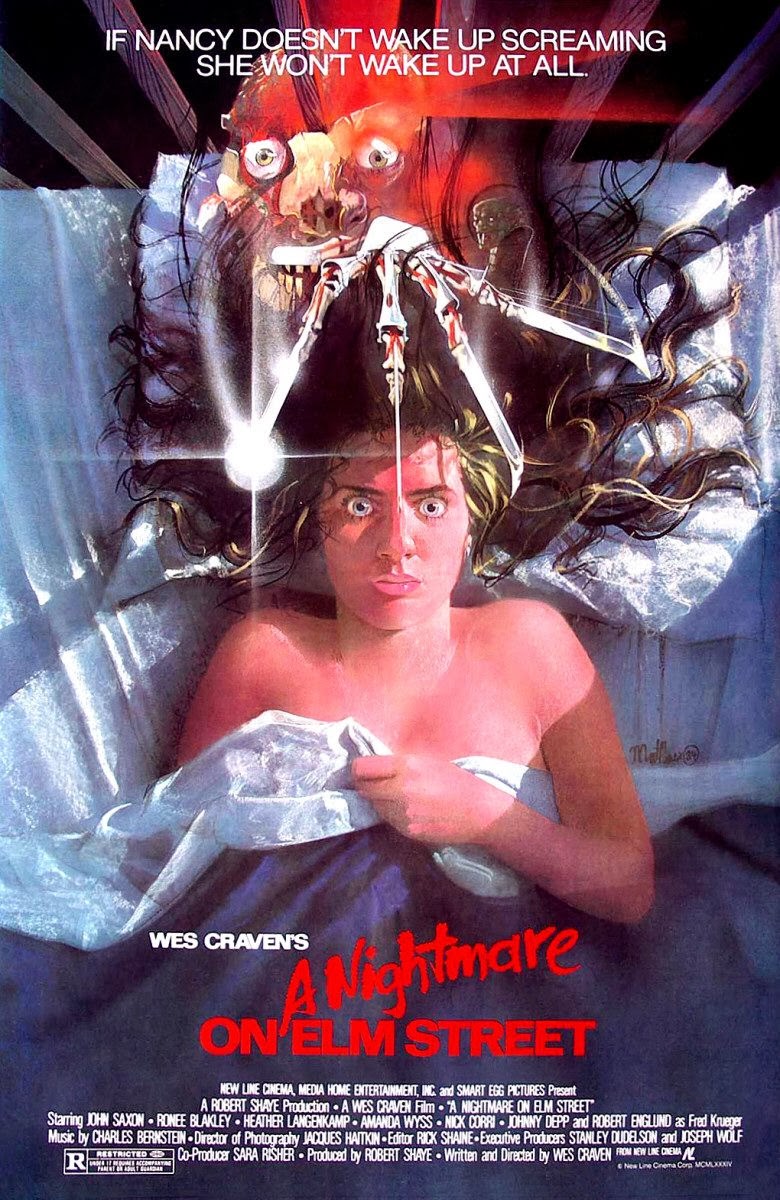
A NIGHTMARE ON ELM STREET (1984)

Country: U.S.A.
Genre(s): Horror
Director: Wes Craven
Cast: Heather Langenkamp / Robert Englund / Johnny Depp

Plot
Murdered child killer Freddy Krueger returns from the dead to attack the teenagers of Elm Street in their dreams.


What I Liked
*spoiler alert*
The horror film genre has perhaps more sub-genres and styles than any other.  Supernatural horror, comedy horror, slasher horror, monster horror, splatter horror, the list goes on.  Fans of horror tend to prefer one or two of these styles over the others.  One of the great things about “A Nightmare on Elm Street” is that it meshes together elements from every one of the subgenres I mentioned; and it does that so well that it really stands as a landmark representative for all of them.  Name another horror film that could do that.  Go on….  Even if you’re more of a horror geek than me and you did think of one, it took you a while, didn’t it?

Let’s take each subgenre one by one.  The first one I brought up was supernatural horror.  Well, its villain, Freddy Krueger returns from the dead, inhabiting and manipulating dreams.  No question there.  Comedy Horror; of all the famous ‘80s horror film killers, Freddy is easily the funniest, an endless source of cartoonish violence, clownish facial expressions, and menacing one-liners.  Not to mention director/writer Wes Craven’s practically running amok in this film with self-referential parodies of horror clichés and sarcastic representations of suburban bliss.  Slasher horror; the man’s got knives on four of his fingers and spends all his time hunting down teenage girls.  If that isn’t a slasher, I don’t know what is.  Monster horror; he’s cursed and grotesquely deformed.  He’s the living dead.  In your dreams, he can appear as anything.  He’s really a classic movie monster in much the same way the Universal monsters were.  Splatter horror.  I can’t imagine that filmgoers of the 1980s had ever seen as much blood in a mainstream movie theater, except for maybe in Craven’s own earlier entries, “Last House on the Left” and “The Hills Have Eyes.”  This one really does have something for everyone.  Provided you’re a fan of some kind of horror, that is.

So, now that I’ve taken too long to prove that point, let’s get to the reason why I really like this movie.  It’s just one surreal ride.  Full of primary colors, hallucinatory dream sequences, copious blood, and logic-defying effects, the film stands as a testament to how truly entertaining horror can be on a shoe-string budget.  The best effect is easily when Johnny Depp is transformed into a gravity-defying fountain of blood.  Even nearly 30 years later, it’s hard to top “Nightmare” a combination of both shocks and laughs.


What I Didn’t Like
Hampered by a limited budget and technological capabilities, some of the effects in the movie just seem silly to watch now.  However, the effects that do work, work incredibly well, enough so that the goofiness of the rest are easily overlooked.

While we're on the topic of what really works, Freddy should have had more screen time.  Who cares about whiny Heather Langenkamp.  I was more of Freddy’s stalking through the shadows and cheezy wisecracks.


Most Memorable Scene
Needless to say, Freddy is what made this movie stand apart from the hordes of other teen-oriented horror flicks being shoveled onto the market in the 1980s.  For me, his tour de force moment is when a seemingly risen-from-the-grave Tina, clad in body bag and dried blood, lures Nancy into Freddy’s boiler room lair.  The use of the camera, shadows, timing, and perhaps the best horror score of the decade turn a high school into a truly chilling living nightmare.  It’s the most believable, tense, and ultimately frightening of the film's many scary moments.


My Rating: 4 out 5

Saturday, October 26, 2013

KING OF NEW YORK (1990)

Country: U.S.A.
Genre(s): Crime
Director: Abel Ferrera
Cast: Christopher Walken / Victor Argo / Laurence Fishburne

Plot
Released after years in prison, drug kingpin Frank White looks to turn over a new leaf, but his quest for redemption leads him directly into a bloody new war for control of the streets.

What I Liked
I used to own "King of New York" on DVD but I don't anymore.  I must have sold it for quick money at some point.  Anyway, it's on Netflix now; so no worries.

The cast of “King of New York” is its true appeal.  First and foremost is of course Christopher Walken, who is at his devilishly charming best as Frank White, the mob boss who is as charismatic as he is chilling.  He plays White with a freaky confidence that makes one feel as though Walken might relate to this coldblooded killer a little too much.  Personally, that just made me like it more.  He’s backed by a supporting cast of future stars: Laurence Fishburne, Wesley Snipes, David Caruso, Steve Buscemi, and B-movie stalwart Victor Argo.  All are perfectly cast in their roles, and watching them all work together is half the fun of the movie.

Despite its over-the-top violence, modern setting, and focus on today’s drugs instead of prohibited alcohol, “King of New York” has as much in common with the classic gangster films of the 1930s as it does other gangster flicks of the 1990s.  Whereas other modern crime epics like “Casino” or “Donnie Brasco” focus on what it’s truly like to live as middle management inside of a criminal organization, “King of New York” focuses on a charismatic and frightening individual whose ambition and bloodthirstiness allows him to dominate his peers.  That kind of plot harkens back to “Little Caesar” or “Public Enemy.”  While films like “Goodfellas” focus on the gritty realities of murder, the way that “King of New York” treats murder as an enjoyable game recalls the carefree killing of the original “Scarface.”  To be honest, I actually prefer the modern day classics to their older influences, but the makers of this one did a nice job of straddling both eras.


What I Disliked
The movie’s strength can also be its weakness.  The same wildness that reminds me of the classic gangster films of yesteryear also brands the movie as too silly to take seriously.  Cult film director Abel Ferrera is not known for his subtlety.  He reinforced that reputation with “King of New York.”  There’s so much over-the-top, stylized violence in this movie that it sometimes verges into slapstick territory.  The bullet-riddled gang war scenes amount to massacres on a preposterous scale.

Without its terrific cast, this one might have gone straight-to-video.  As it is, it's an unusual gangster film, but not an essential one.


Most Memorable Scene
Ferrera’s talent for stylish violence is best on display after a team of cops ambush Frank and his sidekick Jimmy (Fishburne).  When Frank and Jimmy try to make their escape in a limo, a manic and gruesome car chase ensues, immediately followed by a beautifully shot outdoor scene where Wesley Snipes hunts down Lawrence Fisburne.  Ferrera makes wonderful use of the location, the rain, and the shadows to bring a nightmarish, post-apocalyptic feel to the New York night.  I’m certain that anytime “King of New York” is mentioned to someone who has seen this movie, its visuals from this scene that flash through their mind.


My Rating: 3 out of 5

Wednesday, October 23, 2013

DUMBO (1941)

Country: U.S.A.
Genre(s): Animated / Comedy / Fantasy / Musical
Director: Ben Sharpsteen
Cast: Edward Brophy / Herman Bing / Verna Felton

Plot
Humiliated by the other animals and performers because of his freakishly huge ears, baby circus elephant Dumbo finds friendship and self-confidence with the help of Timothy Q. Mouse.


What I Liked
If one had the task of showing some unfortunate soul who had never heard of Disney one picture to sum up what the first spate of Disney films were like, “Dumbo” wouldn’t be a bad choice for the most definitive of them all.  True, there are none of the company’s famous princesses.  But everything else is here: the anthropomorphic animals; an immaculately innocent protagonist; an encouraging sidekick; a quest for self-confidence; and of course the bright, colorful animation and award-winning music.

Also like many of the best Disney flicks, “Dumbo” moves along at a brisk pace.  It’s the shortest of the early animated features and, during its brief run, packs in plenty of visual spectacle and shameless sentimentality to keep a viewer of any age entertained.

Glowing with an innocence long since considered passé in motion pictures, even in children’s films, this movie may be a relic by today’s standards; but it’s a heart-warming, charming relic.


What I Didn’t Like
*spoiler alert*
[Do I even need to include a spoiler alert for a classic kid’s movie, the story to which everyone knows?]
I have to say it; I was completely let down by the ending of the film.  Dumbo finally gets to flying and I’m thinking that I’m really going to be in for some fun viewing now.  Then the movie ends.  Bam!  One full on aerial animation scene and we’re done.  What a gyp! (With apologies to any gypsy filmgoers who may read my blog.

While we’re talking about letdowns, the songs to this film may have won the Academy Award for that year, but the field must have been pretty weak because there’s not a true classic in the entire soundtrack.  “When I See An Elephant Fly” is the best of the bunch by a long shot.  It’s 1940s Disney attempt at being jazzy, so it is of course sung by some stereotypical blackbirds, one named (ahem) Jim Crow.  It is admittedly catchy in a foot-tapping sort of way.  But there’s nothing here approaching the kind of music one gets in “Snow White,” “Pinocchio,” “The Jungle Book,” or even “The Lion King.”


Most Memorable Scene
Sorry, I have to pick two scenes here.

In terms of animation, the most impressive is the hallucinatory dream/nightmare filled with pink elephants which Dumbo and Timothy share after accidentally getting drunk.  Surely nothing like it had existed in animated film before.  In fact, it strikes me more as something from the mind of Rob Zombie than those of the people at Walt Disney Studios in the 1940s.

For tugging at the heart strings, nothing beats watching cute little Dumbo cuddle up for a swing on his imprisoned mother’s trunk.  Like I said earlier, shamelessly sentimental; but they are oh so good at it.


My Rating: 3.5 out 5

Friday, October 18, 2013

THE MUSIC ROOM (1958)

A.K.A.: Jalsaghar
Country: India
Genre(s): Drama
Director: Satyajit Ray
Cast: Chhabi Biswas / Tulsi Lahiri / Gangapada Basu


Plot
Having spent the family wealth on a lifetime of extravagance, a nobleman becomes a brooding recluse in his palace home.


What I Liked
The striking visual power of this film is so perfect it borders on magical.  Where most dramas are usually dialogue-heavy, the filmmakers behind “The Music Room” used dialogue sparingly, replacing words with framing and camera work to convey both story and emotion. Nearly the entire film is shot inside a vast, ornate palace, decorated from ceiling to floor with the finest art and furnishings.  Yet, despite the décor, the house is unimaginably hollow, made a metaphor for loss by the masterful cinematography, which expresses the loneliness of the film’s main character.  There are a lot of films out there with impressive cinematography; few film made after the silent era, if any, boast cinematography so integral to the plot as does “The Music Room.”

Never extravagant or melodramatic, the subtle performances Chhabi Biswas as the main character and Tulsi Lahiri as his manservant are also what helps keep this slow-paced film interesting.  Biswas in particular was handed a character that is hard to feel sorry for, yet that character is the all-important protagonist.  That he makes this spoiled man of privilege who treats everyone around him like dirt at least a little relatable and sympathetic is a major accomplishment on his part.


What I Didn’t Like
This movie is dreadfully slow.  It takes forever for anything to happen and most of the things that do end up happening honestly left me indifferent.  It is the visual beauty of the film that I most admire, not so much the plot or drama.

And call me insensitive or politically incorrect, but the atonal traditional music of India is just dreadful on my Western ears.  This movie did not need trance-inducing music to make its American viewers even sleepier; the story can do that all on its own.  Though I must admit there is a pretty impressive dance number by a woman in the film’s climax, set to an all-too-irritating soundtrack.


Most Memorable Scene
There are several dramatic moments from the film that do manage to remain in my mind a day after I have finished watching it.  But really, the most impactful scenes are those without words and often without people in them; those are the ones that I’m sure will define the movie in my memory.  These are the wonderfully framed portraits of the empty rooms and halls of the palace that I mentioned earlier.  These visuals are beautiful and disturbing all at once.


My Rating: 2.5 out 5