Sunday, January 5, 2014

THE KILLING OF A CHINESE BOOKIE (1976)

Country: U.S.A.
Genre(s): Crime / Drama
Director: John Cassavetes
Cast: Ben Gazzara / Seymour Cassel / Azizi Johari

Plot
The owner a sleazy strip joint falls in debt to some local gangsters, who persuade him to commit murder as means of payback.

What I Liked
While I watched “The Killing of a Chinese Bookie,” I couldn’t help but be reminded of “Mean Streets.”  Both films are relatively low-budget 1970s films; both are street-level crime dramas about men who wind up in over their heads with the wrong crowd; both feature highly improvised scripts and naturalistic performances.  So it was no surprise to later learn that director/writer John Cassavetes planned the film with the help of Martin Scorsese, the man behind “Mean Streets.”  I really enjoyed “Mean Streets,” and this movie kept me pretty well entertained as well.

“The Killing of a Chinese Bookie” shows off a lot more flesh and violence than does “Mean Streets,” and it’s clearly intentional.  You can’t set your film in a strip club and cast it with half a dozen mind-bogglingly buxom starlets from various porn and exploitation films without making an obvious ploy to pull in and entertain a certain kind of audience.  Thus Cassavetes and crew certainly cross-cross the line between sleaze and art and back again, but I really have no problem with that.  When the story slows down, at least one can always stare at the objectified women decorating the background.  Besides, and independent filmmaker Cassavetes problem couldn’t have gotten the funding to make his movie without a “sex sells” hook to convince investors that people would pay to watch it.

Even more captivating than the tits and murder, though, is the performance of lead Ben Gazzara.  One could argue that Gazzara always plays sleazeballs and criminal-types, which is exactly what he plays here.  What that argument misses, however, is that Gazzara brings a depth to the roll of main character Cosmo Vitelli that makes his character charming, repulsive, and, most unexpectedly, sympathetic.  Vitelli is a man who gets by on pure charisma and ego, charming the low-lifes and nitwits in his insular world into thinking the world revolves around him.  However, when he steps outside of that sphere of influence, he is just a man who is lost, desperate, and worst of all, uncomfortable.


What I Didn’t Like
“The Killing of a Chinese Bookie” is that kind of independent 1970s filmmaking that one just doesn’t find anymore.  Killed off by the big-budget, slick, corporate productions of the next decade, they featured looser storytelling, improvised performances, a notable lack of special effects, sometimes bad lighting, and main characters who were sometimes difficult to like.  I personally enjoy many of these movies, this one included.  But those who aren’t used to this kind of filmmaking might find “The Killing of a Chinese Bookie” difficult to endure.


Most Memorable Scene
*spoiler alert!*
The further and further away Cosmo Vitelli moves from his club, the more insecure and frightened he becomes.  This is never more true than during the event described in the film’s title.  Right in the middle of the film we’re given the film’s most intense sequence as Vitelli, who can seemingly do no wrong in his own world, is reduced to nothing but a desperate, paranoid murderer, on the run for his life and seeking any way he can to return to the comfort of what he knows.


My Rating: 4 out of 5

Thursday, October 31, 2013

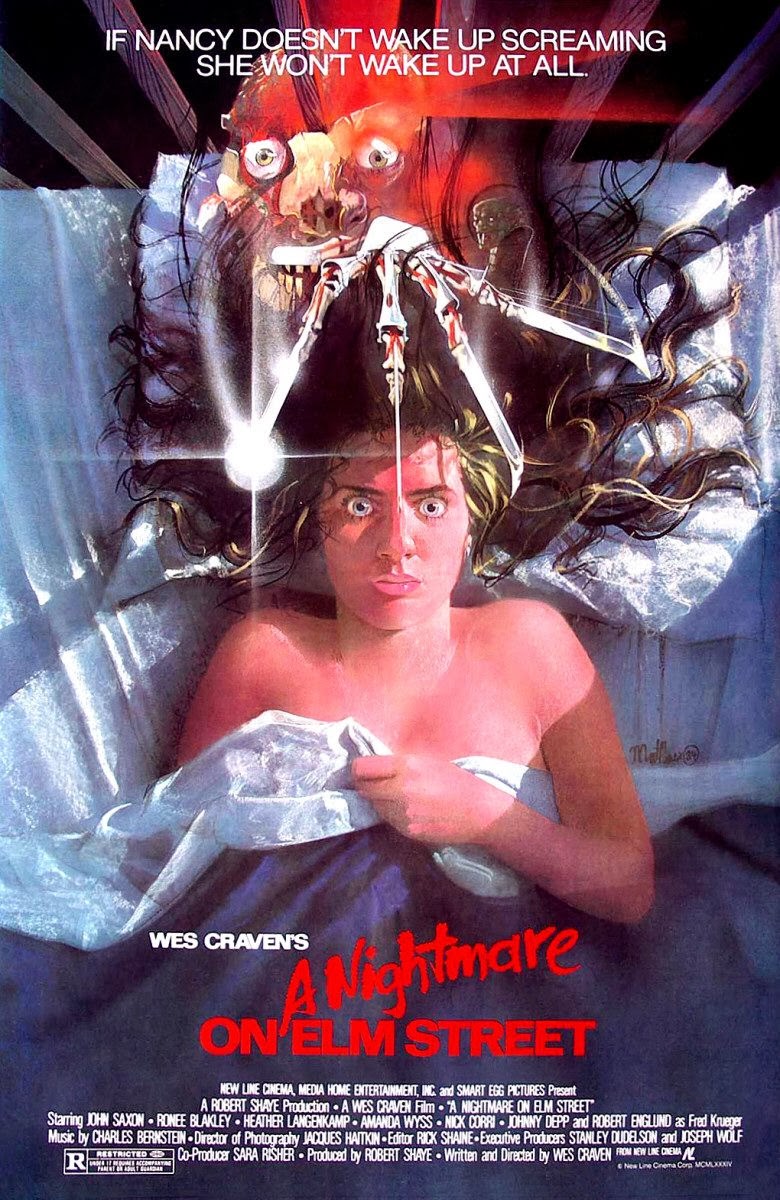
A NIGHTMARE ON ELM STREET (1984)

Country: U.S.A.
Genre(s): Horror
Director: Wes Craven
Cast: Heather Langenkamp / Robert Englund / Johnny Depp

Plot
Murdered child killer Freddy Krueger returns from the dead to attack the teenagers of Elm Street in their dreams.


What I Liked
*spoiler alert*
The horror film genre has perhaps more sub-genres and styles than any other.  Supernatural horror, comedy horror, slasher horror, monster horror, splatter horror, the list goes on.  Fans of horror tend to prefer one or two of these styles over the others.  One of the great things about “A Nightmare on Elm Street” is that it meshes together elements from every one of the subgenres I mentioned; and it does that so well that it really stands as a landmark representative for all of them.  Name another horror film that could do that.  Go on….  Even if you’re more of a horror geek than me and you did think of one, it took you a while, didn’t it?

Let’s take each subgenre one by one.  The first one I brought up was supernatural horror.  Well, its villain, Freddy Krueger returns from the dead, inhabiting and manipulating dreams.  No question there.  Comedy Horror; of all the famous ‘80s horror film killers, Freddy is easily the funniest, an endless source of cartoonish violence, clownish facial expressions, and menacing one-liners.  Not to mention director/writer Wes Craven’s practically running amok in this film with self-referential parodies of horror clichés and sarcastic representations of suburban bliss.  Slasher horror; the man’s got knives on four of his fingers and spends all his time hunting down teenage girls.  If that isn’t a slasher, I don’t know what is.  Monster horror; he’s cursed and grotesquely deformed.  He’s the living dead.  In your dreams, he can appear as anything.  He’s really a classic movie monster in much the same way the Universal monsters were.  Splatter horror.  I can’t imagine that filmgoers of the 1980s had ever seen as much blood in a mainstream movie theater, except for maybe in Craven’s own earlier entries, “Last House on the Left” and “The Hills Have Eyes.”  This one really does have something for everyone.  Provided you’re a fan of some kind of horror, that is.

So, now that I’ve taken too long to prove that point, let’s get to the reason why I really like this movie.  It’s just one surreal ride.  Full of primary colors, hallucinatory dream sequences, copious blood, and logic-defying effects, the film stands as a testament to how truly entertaining horror can be on a shoe-string budget.  The best effect is easily when Johnny Depp is transformed into a gravity-defying fountain of blood.  Even nearly 30 years later, it’s hard to top “Nightmare” a combination of both shocks and laughs.


What I Didn’t Like
Hampered by a limited budget and technological capabilities, some of the effects in the movie just seem silly to watch now.  However, the effects that do work, work incredibly well, enough so that the goofiness of the rest are easily overlooked.

While we're on the topic of what really works, Freddy should have had more screen time.  Who cares about whiny Heather Langenkamp.  I was more of Freddy’s stalking through the shadows and cheezy wisecracks.


Most Memorable Scene
Needless to say, Freddy is what made this movie stand apart from the hordes of other teen-oriented horror flicks being shoveled onto the market in the 1980s.  For me, his tour de force moment is when a seemingly risen-from-the-grave Tina, clad in body bag and dried blood, lures Nancy into Freddy’s boiler room lair.  The use of the camera, shadows, timing, and perhaps the best horror score of the decade turn a high school into a truly chilling living nightmare.  It’s the most believable, tense, and ultimately frightening of the film's many scary moments.


My Rating: 4 out 5

Saturday, October 26, 2013

KING OF NEW YORK (1990)

Country: U.S.A.
Genre(s): Crime
Director: Abel Ferrera
Cast: Christopher Walken / Victor Argo / Laurence Fishburne

Plot
Released after years in prison, drug kingpin Frank White looks to turn over a new leaf, but his quest for redemption leads him directly into a bloody new war for control of the streets.

What I Liked
I used to own "King of New York" on DVD but I don't anymore.  I must have sold it for quick money at some point.  Anyway, it's on Netflix now; so no worries.

The cast of “King of New York” is its true appeal.  First and foremost is of course Christopher Walken, who is at his devilishly charming best as Frank White, the mob boss who is as charismatic as he is chilling.  He plays White with a freaky confidence that makes one feel as though Walken might relate to this coldblooded killer a little too much.  Personally, that just made me like it more.  He’s backed by a supporting cast of future stars: Laurence Fishburne, Wesley Snipes, David Caruso, Steve Buscemi, and B-movie stalwart Victor Argo.  All are perfectly cast in their roles, and watching them all work together is half the fun of the movie.

Despite its over-the-top violence, modern setting, and focus on today’s drugs instead of prohibited alcohol, “King of New York” has as much in common with the classic gangster films of the 1930s as it does other gangster flicks of the 1990s.  Whereas other modern crime epics like “Casino” or “Donnie Brasco” focus on what it’s truly like to live as middle management inside of a criminal organization, “King of New York” focuses on a charismatic and frightening individual whose ambition and bloodthirstiness allows him to dominate his peers.  That kind of plot harkens back to “Little Caesar” or “Public Enemy.”  While films like “Goodfellas” focus on the gritty realities of murder, the way that “King of New York” treats murder as an enjoyable game recalls the carefree killing of the original “Scarface.”  To be honest, I actually prefer the modern day classics to their older influences, but the makers of this one did a nice job of straddling both eras.


What I Disliked
The movie’s strength can also be its weakness.  The same wildness that reminds me of the classic gangster films of yesteryear also brands the movie as too silly to take seriously.  Cult film director Abel Ferrera is not known for his subtlety.  He reinforced that reputation with “King of New York.”  There’s so much over-the-top, stylized violence in this movie that it sometimes verges into slapstick territory.  The bullet-riddled gang war scenes amount to massacres on a preposterous scale.

Without its terrific cast, this one might have gone straight-to-video.  As it is, it's an unusual gangster film, but not an essential one.


Most Memorable Scene
Ferrera’s talent for stylish violence is best on display after a team of cops ambush Frank and his sidekick Jimmy (Fishburne).  When Frank and Jimmy try to make their escape in a limo, a manic and gruesome car chase ensues, immediately followed by a beautifully shot outdoor scene where Wesley Snipes hunts down Lawrence Fisburne.  Ferrera makes wonderful use of the location, the rain, and the shadows to bring a nightmarish, post-apocalyptic feel to the New York night.  I’m certain that anytime “King of New York” is mentioned to someone who has seen this movie, its visuals from this scene that flash through their mind.


My Rating: 3 out of 5

Wednesday, October 23, 2013

DUMBO (1941)

Country: U.S.A.
Genre(s): Animated / Comedy / Fantasy / Musical
Director: Ben Sharpsteen
Cast: Edward Brophy / Herman Bing / Verna Felton

Plot
Humiliated by the other animals and performers because of his freakishly huge ears, baby circus elephant Dumbo finds friendship and self-confidence with the help of Timothy Q. Mouse.


What I Liked
If one had the task of showing some unfortunate soul who had never heard of Disney one picture to sum up what the first spate of Disney films were like, “Dumbo” wouldn’t be a bad choice for the most definitive of them all.  True, there are none of the company’s famous princesses.  But everything else is here: the anthropomorphic animals; an immaculately innocent protagonist; an encouraging sidekick; a quest for self-confidence; and of course the bright, colorful animation and award-winning music.

Also like many of the best Disney flicks, “Dumbo” moves along at a brisk pace.  It’s the shortest of the early animated features and, during its brief run, packs in plenty of visual spectacle and shameless sentimentality to keep a viewer of any age entertained.

Glowing with an innocence long since considered passé in motion pictures, even in children’s films, this movie may be a relic by today’s standards; but it’s a heart-warming, charming relic.


What I Didn’t Like
*spoiler alert*
[Do I even need to include a spoiler alert for a classic kid’s movie, the story to which everyone knows?]
I have to say it; I was completely let down by the ending of the film.  Dumbo finally gets to flying and I’m thinking that I’m really going to be in for some fun viewing now.  Then the movie ends.  Bam!  One full on aerial animation scene and we’re done.  What a gyp! (With apologies to any gypsy filmgoers who may read my blog.

While we’re talking about letdowns, the songs to this film may have won the Academy Award for that year, but the field must have been pretty weak because there’s not a true classic in the entire soundtrack.  “When I See An Elephant Fly” is the best of the bunch by a long shot.  It’s 1940s Disney attempt at being jazzy, so it is of course sung by some stereotypical blackbirds, one named (ahem) Jim Crow.  It is admittedly catchy in a foot-tapping sort of way.  But there’s nothing here approaching the kind of music one gets in “Snow White,” “Pinocchio,” “The Jungle Book,” or even “The Lion King.”


Most Memorable Scene
Sorry, I have to pick two scenes here.

In terms of animation, the most impressive is the hallucinatory dream/nightmare filled with pink elephants which Dumbo and Timothy share after accidentally getting drunk.  Surely nothing like it had existed in animated film before.  In fact, it strikes me more as something from the mind of Rob Zombie than those of the people at Walt Disney Studios in the 1940s.

For tugging at the heart strings, nothing beats watching cute little Dumbo cuddle up for a swing on his imprisoned mother’s trunk.  Like I said earlier, shamelessly sentimental; but they are oh so good at it.


My Rating: 3.5 out 5

Friday, October 18, 2013

THE MUSIC ROOM (1958)

A.K.A.: Jalsaghar
Country: India
Genre(s): Drama
Director: Satyajit Ray
Cast: Chhabi Biswas / Tulsi Lahiri / Gangapada Basu


Plot
Having spent the family wealth on a lifetime of extravagance, a nobleman becomes a brooding recluse in his palace home.


What I Liked
The striking visual power of this film is so perfect it borders on magical.  Where most dramas are usually dialogue-heavy, the filmmakers behind “The Music Room” used dialogue sparingly, replacing words with framing and camera work to convey both story and emotion. Nearly the entire film is shot inside a vast, ornate palace, decorated from ceiling to floor with the finest art and furnishings.  Yet, despite the décor, the house is unimaginably hollow, made a metaphor for loss by the masterful cinematography, which expresses the loneliness of the film’s main character.  There are a lot of films out there with impressive cinematography; few film made after the silent era, if any, boast cinematography so integral to the plot as does “The Music Room.”

Never extravagant or melodramatic, the subtle performances Chhabi Biswas as the main character and Tulsi Lahiri as his manservant are also what helps keep this slow-paced film interesting.  Biswas in particular was handed a character that is hard to feel sorry for, yet that character is the all-important protagonist.  That he makes this spoiled man of privilege who treats everyone around him like dirt at least a little relatable and sympathetic is a major accomplishment on his part.


What I Didn’t Like
This movie is dreadfully slow.  It takes forever for anything to happen and most of the things that do end up happening honestly left me indifferent.  It is the visual beauty of the film that I most admire, not so much the plot or drama.

And call me insensitive or politically incorrect, but the atonal traditional music of India is just dreadful on my Western ears.  This movie did not need trance-inducing music to make its American viewers even sleepier; the story can do that all on its own.  Though I must admit there is a pretty impressive dance number by a woman in the film’s climax, set to an all-too-irritating soundtrack.


Most Memorable Scene
There are several dramatic moments from the film that do manage to remain in my mind a day after I have finished watching it.  But really, the most impactful scenes are those without words and often without people in them; those are the ones that I’m sure will define the movie in my memory.  These are the wonderfully framed portraits of the empty rooms and halls of the palace that I mentioned earlier.  These visuals are beautiful and disturbing all at once.


My Rating: 2.5 out 5

Saturday, September 21, 2013

FOUR LIONS (2010)

Country: U.K.
Genre(s): Comedy / Drama
Director: Christopher Morris
Cast: Riz Ahmed / Nigel Lindsay / Kayvan Novak

Plot
Four British Muslims plot to martyr themselves in a coordinated suicide bomb attack.  Their only problem is that they’re all idiots.


What I Liked
There’s no getting around it; the movie’s damn funny.  When one first hears/reads that the film is about terrorist plotting a suicide bombing, comedy isn’t the fight genre that might come to mind.  In fact, when one learns it is a comedy, one might take offense.  After all, most would agree that mass killing is no laughing matter.  “Four Lions” will make you laugh out loud, despite yourself.  The film presents the quite plausible hypothesis that most terrorists are far from the mysterious, mad geniuses or even the devout religious fanatics they are often portrayed as being in film; they’re dumbasses who can’t get themselves organized, constantly screw up at every endeavor, and could care less about the Koran.

However this is no bare-bones “Three Stooges” serving of buffoonery (Don’t get me wrong, I love the Stooges).  Despite their imbecility, the characters in “Four Lions” are never allowed to become simply caricatures; they are very well fleshed-out characters both emotionally and psychologically and thus seem entirely believable.  Which is where the film is truly frightening.  Every laugh comes with a twinge of fear, yet the laughs are unavoidable.


What I Didn’t Like
Of course, as I mentioned previously, there is often an uncomfortable feeling one gets due to the subject matter of the movie; but that’s part of the films point and part of what makes it so funny.  Just know that it’s there.

While this film is terrifically funny, part of its humor relies upon the very shock of taking people who are regarded as such devious villains in popular culture and turning all of that on its head with pure silliness.  Much of the comedy that takes place on screen wouldn’t be so funny if it wasn’t making fun of aspiring mass murderers.  Take away the novelty of the subject matter, and the film would be about half as funny.


Most Memorable Scene
You can see some of these gags coming long before they happen, but they’re executed so well that the laughs never suffer.  The one involving a bazooka being shot at a U.S. drone has been done countless times on film and television, but still had me in stitches.  Funniest moment of the movie.


My Rating: 3 out of 5

Sunday, September 8, 2013

THINGS TO COME (1936)

Country: U.K.
Genre(s): Science Fiction
Director: William Cameron Menzies
Cast: Raymond Massey / Ralph Richardson / Margaretta Scott

Plot
A hypothetical future for mankind is traced from the prediction of a second World War through to a 21st century utopia.


What I Liked
Conceptually, “Things to Come” is a compelling future history of mankind in the twentieth and twenty-first centuries, laying out H.G. Wells’ prediction for the course of civilization to come with technical mastery and visual flair.  Scripted by Wells himself from his own book “The Shape of Things to Come,” the movie is more about philosophy and ideas than drama.  He may have gotten many of the details of what would actually happen incorrect, but he was certainly correct about the philosophical conflicts that would pervade political, ethical, and theoretical debate today.  Of course many of those conflicts were the same conflicts which had dominated human discourse for millennia by 1936, but Wells and the filmmakers successfully transport the themes of man’s history into the future by interpreting their relevance through illustrations of the unprecedented power technology has to annihilate or enhance civilization.  As the film draws to a close, the ethical questions become easier to recognize until finally we are given Wells’ answer to those dilemmas through the parting words of progressive dictator Oswald Cabal.

While the concepts are what linger the longest in the viewer’s mind after its conclusion, during the actual viewing experience it is the visual design of the film that most impresses.  Using a vast arsenal of established special effects tricks and probably a few that were brand new, the filmmakers bring us dystopian landscapes, frightening war machines, flying fortresses, massive machines, futuristic factories, giant space guns, and underground metropolises, most of which remains passable here in the future the film tries to predict.  Most intriguing of all is the set design and cinematography, which bestow upon those sets and props an intimidating yet exciting vastness.  Even movie theater signs have a titanic boldness.  It is its sheer look that would prove the most influential element of the film, more-so than its messages or effects.


What I Didn’t Like
The movie is based on a Wells book that was more of a treatise on man’s greatness and folly than it was a novel and, like the book, the movie lacks the necessary structure to make for effective storytelling.  To accommodate for the century of time the movie intends to cover in less than two hours’ time, the story jumps ahead through the decades, stopping at key points for dramatic vignettes.  At each stop we are introduced to new characters, though some of the older ones sometimes remain.  But we never stay long enough to feel any emotional connection to the characters or their conflicts.  The viewer is unable to get involved in the movie on anything more than an intellectual level because of the overly ambitious enormity of the narrative.  It is unfortunately a glaring shortcoming that ultimately weakens the impact of the messages Wells and the filmmakers try to convey.


Most Memorable Scene
Once the movie jumps into the twenty-first century the viewer is treated to a montage of special effects meant to introduce us to the utopian civilization that has finally arisen out of the earlier dark ages brought on by war and disease.  It is a world dominated by technology, science, and sterility.  The use of various effects, often multiple techniques in the same shot, allows this moment of the movie to retain some of its original “wow” factor.


My Rating: 2.5 out of 5

Saturday, August 31, 2013

THE MAN WHO SHOT LIBERTY VALANCE (1962)

Country: U.S.A.
Genre(s): Western
Director: John Ford
Cast: James Stewart / John Wayne / Lee Marvin

Plot
A U.S. Senator returns to the Western town where he made his reputation and reveals the long-hidden secret behind his legendary rivalry with the dangerous killer Liberty Valance.


What I Liked
Much has been made about the moral complexity of “The Man Who Shot Liberty Valance,” and with good reason.  Much like “The Searchers” (also directed by John Ford) this film pulls back at least some of the curtain of myth and simplicity presented in the Hollywood Westerns that preceded it.  In fact, it is sort of a precursor to the more mature Westerns to come, such as “Butch Cassidy and the Sundance Kid” and “The Assassination of Jesse James,” in which the heroes of the films are incapable of living up to the legends surrounding them.  Also like in those other two films, this one represents the American West at a bittersweet moment in history, when the Old West (represented by John Wayne’s Tom Doniphan) was beginning to give way to the coming of law and order (represented by Jimmy Stewart’s Ransom Stoddard).  Wayne’s mythological cowboy hero, as a man who is his own law, is on the fast track to obsolete and realizes it.  Yet the entire film, from start to finish, laments the loss of the old ways, even as it recognizes the necessity of the new.  In short, thanks to Ford’s ever-maturing approach to the Western, there’s more underlying complexity in “The Man Who Shot Liberty Valance,” than in the vast majority of the Hollywood Westerns that preceded it.


What I Didn’t Like
For all that it challenged, the movie still needed to remain viable box office entertainment for the masses.  That meant adhering to certain preconceived notions held by the film-going audience of its era.  The big name actors all stick pretty much to the types we’re used to seeing from them.  Stewart is the wide-eyed crusader who is honest to a fault.  Wayne is the brawny man of action.  Lee Marvin is a tough-talking, violent badass.  And Andy Devine is the comic relief, a well-meaning buffoon.  One could see all that as perfect casting, but in a film that questions so much about American myth-making, it would have been nice to see these major stars break from their own myths.  Visually, the film still exhibits much of the silliness that was commonplace in Westerns of the period.  The streets and people are all too clean; the clothing and sets too new looking.  “When the legend becomes fact, print the legend” says a character in the film.  It’s the most famous line of the movie and the sentiment informs the entire film, thematically.  In the case of “The Man Who Shot Liberty Valance,” there’s still much more legend than fact; and, in the early 1960's, audiences were absolutely fine with that.


Most Memorable Scene
Jimmy Stewart’s character gets a not-so-warm welcome from Liberty Valance and his gang early in the film.  It’s a rude awakening for Stewart as to what he’s up against with his arrival in the West and introduces the conflict that will define his character’s arc through the rest of the film.  It’s all surprisingly violent and sadistic for a film of the period.  It is a nice grab for the viewer’s attention after a fairly drawn-out and dull prologue.


My Rating: 3.5 out of 5

Thursday, August 29, 2013

ORDINARY PEOPLE (1980)

Country: U.S.A.
Genre(s): Drama
Director: Robert Redford
Cast: Timothy Hutton / Donald Sutherland / Mary Tyler Moore

Plot
Troubled by a tragedy from the past, the members of an otherwise normal suburban family struggle to cope with their loss and relate to one another.


What I Liked
So apparently there’s still anger among certain cinephiles that “Ordinary People” beat out “Raging Bull” for the Best Picture Oscar.  While Scorsese is my favorite director and “Raging Bull” is regarded as one of his undisputed masterpieces, I have to say, I do kind of get why “Ordinary People” was picked.  As a fan of Marty, DeNiro and boxing, the visual character study of Jake LaMotta will always be more entertaining for me, but “Raging Bull” relies so much on shock value and style that it can at times feel as overbearing and brutish as its subject.  Meanwhile, “Ordinary People” is a much more subtle film that is strongest in its moments of silence and simplicity.

To put it another way, “Ordinary People” was far less flashy than “Raging Bull” and dealt with some truths that many viewers might have still feel hit unnervingly close to home.  It is a film that deals largely with what goes unsaid, the conflict played out in frightened stares, nervous gestures, and uncomfortable silences.  That description might make it seem boring, but I personally could not stop watching the movie, thanks to a perfectly paced script with well-rendered, relatable characters.

The fact that every actor with a speaking part is perfectly cast and plays their role flawlessly certainly helps the film retain its intense emotional impact more than thirty years after its release.  In fact, to me, the great Oscar travesty that year was not that this movie beat out “Raging Bull” for Best Picture, but that Timothy Hutton was forced to settle for a Best Supporting Actor Oscar.  Hutton’s character, the anxiety-ridden and depressed teenager Conrad Jarrett is absolutely the main character of the story and Hutton gets far more screen time than either of the more famous people who got top billing in the film (Mary Tyler Moore and Donald Sutherland).  So how exactly did Hutton get demoted to being a supporting actor in the eyes of the Academy?  It is really his career-making performance that is the crux of the film’s plot, conflict, and emotional resonance.


What I Didn’t Like
Particularly when viewed all these years later, with psychology and dysfunctional families very familiar themes in American pop culture, “Ordinary People” never feels particularly original, at least not on the surface.  Even with its title, the filmmakers rely on a movie convention that was already cliché by 1980: the secrets haunting a seemingly perfect suburban neighborhood/household and the myth of “normalcy.”  Charles Laughton, Alfred Hitchcock, Stanley Kramer, Mike Nichols, and John Carpenter had all mined similar themes in various ways previously.  But none did so with the touching realism and absence of ego that director Robert Redford accomplishes here.  His movie is the epitome of substance over style.

Some of the scenes involving Conrad meeting his psychiatrist (played by Judd Hirsch) also now feel a bit silly, full of overacting and cliché confrontations that might have very well felt poignant back in 1980.  The prevalence of therapy as a plot device in film means that these scenes don’t feel as special today as they might have then.


Most Memorable Scene
Hutton’s lunch meeting with an old friend from the hospital has much of that unspoken conflict I mentioned earlier.  There’s a great deal that is revealed here about Conrad here without much being said.  Here are two old friends meeting one another again, separated by time and distance from where they had first come to know one another.  The circumstances of their pasts and their own personal problems prove too strong for either one of them to break through so that they can once again communicate with one another the way they used to.  This movie if filled with tragic failures to communicate, but this one will prove the most tragic of all.


My Rating: 4.5 out of 5

Wednesday, August 7, 2013

CARRIE (1976)

Country: U.S.A.
Genre(s): Horror
Director: Brian De Palma
Cast: Sissy Spacek / Piper Laurie / Betty Buckley

Plot
Shy social outcast Carrie White struggles to understand and control her telekinetic abilities as the high school prom approaches.


What I Liked
*spoiler alert*
My above plot description doesn’t really do justice to the complexity and uniqueness of “Carrie.”  Loaded with underlying commentary about everything from religion, puberty and conformity to parenthood, sexuality, and suburbia, this is one of those movies that can be too easily overlooked as cheap shock value when it is in fact one of the most mature and multi-faceted horror films I have ever seen.

One of the best things about “Carrie” is that the film breaks so many conventions of the horror genre and yet its status as a supreme example of that genre is undeniable.  Take a look at other top horror films of the 1970s (for example, “The Exorcist,” “Texas Chainsaw Massacre,” and “Halloween”) and you’ll find some elements in common.  The killer is the villain.  The protagonist is pursued by, but ultimately escapes from, evil. Frights, shocks, and deaths abound, from start to finish.  None of these apply to “Carrie.”  Here the title character is the only killer, and yet the true villains are her shallow, bullying classmates, who become her victims.  Likewise, our protagonist is the one, ultimately, from whom everyone else must run.  And, most interestingly, the film is almost devoid of the standard horror shock value until its infamous climax (which certainly makes up for lost time).  Until then, we are simply watching a suburban (if supernatural) teen drama.  This isn’t to say there aren’t many hallmarks of horror still present.  The ignorant but well-meaning adults; the religious themes; the focus on sex and sexuality; they’re all very familiar elements (clichés, even) of horror.

Despite its lack of obvious shock elements, “Carrie” is nonetheless haunting from start to finish in large part thanks to Sissy Spacek’s devastating performance.  She conjures up so much feeling from and for her character through the eerie combination of vulnerability and rage that she brings to Carrie, that the movie feels like horror the whole time, without much scary taking place on screen but one actor’s total mastery of her character.  Mentions should also be made of Piper Laurie who is plenty scary as Carrie’s religious zealot mother.


What I Didn’t Like
*spoiler alert*
There’s not much to complain about.  Perhaps one could say the movie is a little slow compared to what a modern horror viewer might expect, but I didn’t feel that slowness at all.  This is just one of those movies which can hypnotize the viewer through its mood and characters.

The only part of the movie that bothers me when watching it is the ending.  Not the whole high-school-gym-bloodbath part.  Love that.  It’s most of what follows.  Mom being stabbed in a position to look like she’s Christ crucified.  The Fall of the House of Usher collapse.  The silly rise-from-the-grave dream sequence at the conclusion.  In a matter of the few closing minutes, director Brian De Palma and screenwriter Lawrence Cohen cave to silliness and cliché, cheapening an otherwise flawless film.


Most Memorable Scene
No contest here.  Even if you haven’t seen the movie, I’m sure you already know what scene in Carrie stands out from all the others.  So why bother saying it.


My Rating: 4.5 out of 5